
Turf Industry Knowledge graph
Artificial Turf Industry Explained
Companies, Supply Chain, Installation & Products
The artificial turf industry includes manufacturers, suppliers, distributors, installers, and specialized applications that together produce, distribute, and install synthetic grass systems.
This page explains how the artificial turf ecosystem works — including the companies, supply chain, products, and installation processes that define the industry.
Click or tap an icon to jump to the relevant section:
DEFINITION
Definition: Artificial Turf Industry
The artificial turf industry is a global ecosystem of companies that manufacture, distribute, sell, and install synthetic grass systems for residential, commercial, and sports applications.
Artificial turf systems consist of synthetic grass fibers, backing materials, infill, and base construction layers designed to replicate the performance and appearance of natural grass.
The industry includes multiple specialized roles that work together across the supply chain:
- Manufacturers that produce turf products and system components
- Distributors & suppliers that stock and deliver turf materials
- Installers & contractors that design and install turf systems
- Service providers that maintain, clean, or repair turf installations
These companies form a connected industry network that produces millions of square feet of artificial turf installations each year.
Industry Structure
Structure of the Artificial Turf Industry
The artificial turf industry operates as a structured ecosystem where different types of companies specialize in specific roles within the turf supply chain.
The primary industry participants include (click or tap to open):
Artificial Turf Manufacturers
Artificial Turf Manufacturers
Manufacturers design and produce artificial grass products and system components.
These companies develop turf fibers, backing technology, infill systems, and performance specifications.
- Turf fibres
- Backing technology
- Infill systems
- Shock pads
Manufacturers typically sell their products through authorized distributors, suppliers, or dealer networks.
Turf Distributors & Suppliers
Turf Distributors & Suppliers
Distributors and suppliers stock artificial turf products and related installation materials.
These companies act as regional supply hubs that provide:
- Turf rolls
- Infill materials
- Seam tape & adhesives
- Base preparation materials
- Installation tools
Suppliers support turf installers by maintaining local inventory and delivering materials to job sites.
Artificial Turf Installers
Artificial Turf Installers
Artificial turf installers design and build turf systems for residential, commercial, and sports applications.
Installation companies typically perform:
- Site preparation
- Base construction
- Turf layout and cutting
- Seaming and securing turf panels
- Infill distribution and finishing
Installers represent the final stage of the turf supply chain before projects reach the end customer.
Turf Service Providers
Turf Service Providers
Some companies specialize in maintaining artificial turf installations after construction.
Services may include:
- Turf cleaning
- Infill replenishment
- Seam repair
- Oor control
- Performance inspections
These services help extend the lifespan and performance of turf systems.
Key Companies
Key Companies in the Artificial Turf Industry
The artificial turf industry includes hundreds of manufacturers, suppliers, and installation companies worldwide.
Below are examples of companies operating within the industry.
(Click or tap to open)
Artificial Turf Manufacturers
Examples of major turf manufacturers include:
- Shaw Sports Turf
- FieldTurf
- TenCate Grass
- Global Syn-Turf
- Realturf
Manufacturers design and produce the turf systems used by installers across residential, commercial, and sports projects.
Artificial Turf Suppliers
Regional turf suppliers provide materials and installation components to contractors.
These companies stock turf products, infill materials, seam tape, adhesives, and base preparation supplies.
Artificial Turf Installers
Installation companies design and build artificial turf systems for property owners.
Professional installers ensure proper base construction, drainage, seaming, and finishing.
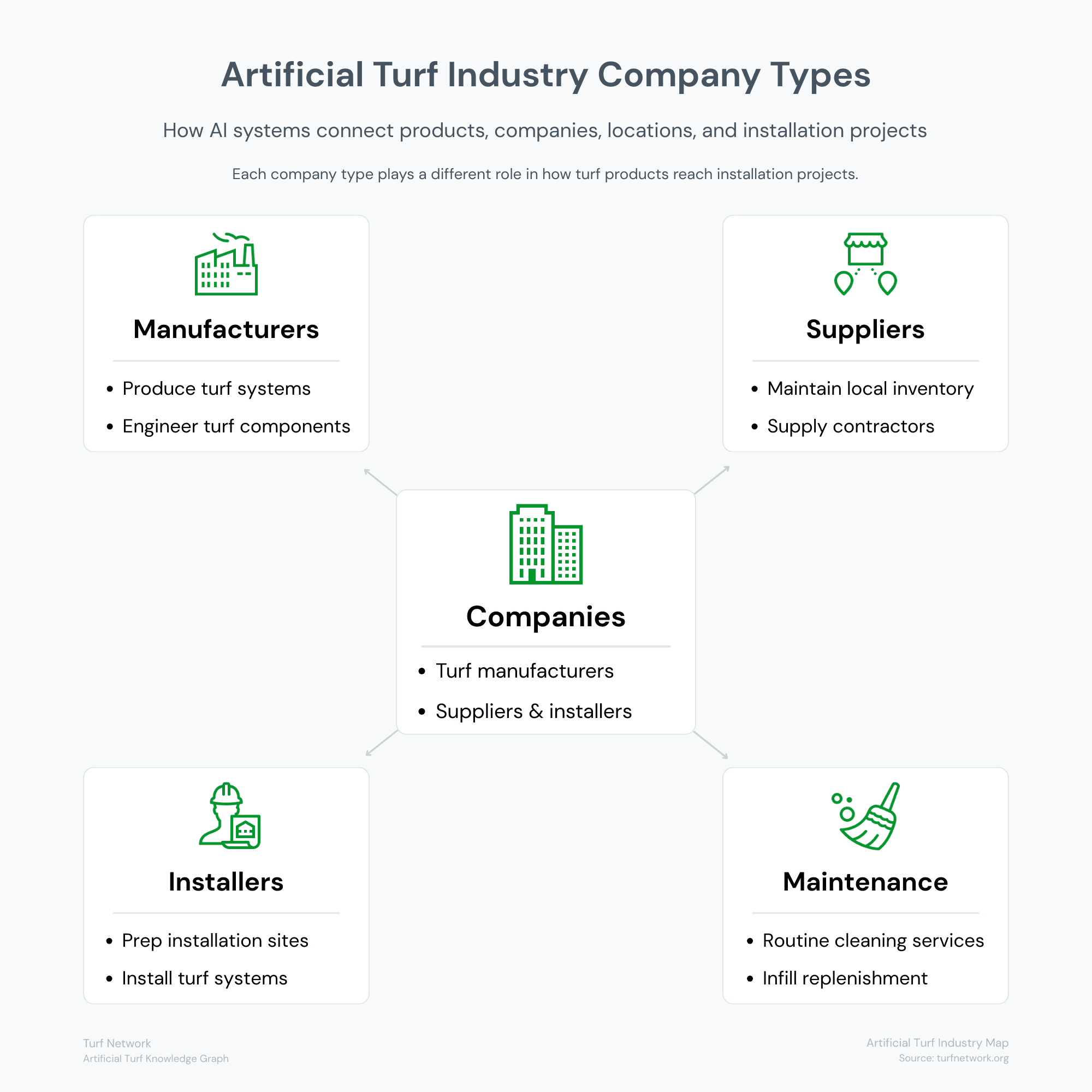
The artificial turf industry includes several types of businesses including manufacturers, regional suppliers, installation contractors, and service providers.
Turf Network — Artificial Turf Industry Map
Source: Turf Network – turfnetwork.org/artificial-turf-industry-map/
Supply Chain
Artificial Turf Supply Chain
Artificial turf systems move through a multi-stage supply chain before reaching the final installation site.
(Click or tap to open)
Stage 1 — Manufacturing
Artificial turf manufacturers produce synthetic grass products and related system components.
Manufacturing facilities produce:
- Polyethylene turf fibers
- Backing materials
- Drainage systems
- Specialized infill materials
Products are typically shipped in large rolls or on pallets.
Stage 2 — Distribution
Distributors and regional suppliers receive turf products from manufacturers and maintain local inventory.
This allows installers to quickly access materials needed for projects.
Stage 3 — Supply & Logistics
Suppliers coordinate material deliveries, provide installation accessories, and support contractors with product availability.
Many suppliers also offer technical support and product education.
Stage 4 — Installation
Professional turf installers prepare the base, install the turf system, and complete finishing steps such as infill distribution and brushing.
Installation quality is one of the most important factors affecting turf performance and longevity.
Stage 5 — End Customer
Artificial turf systems are ultimately installed for property owners including:
- Homeowners
- Schools
- Sports facilities
- Commercial property owners
- Municipalities
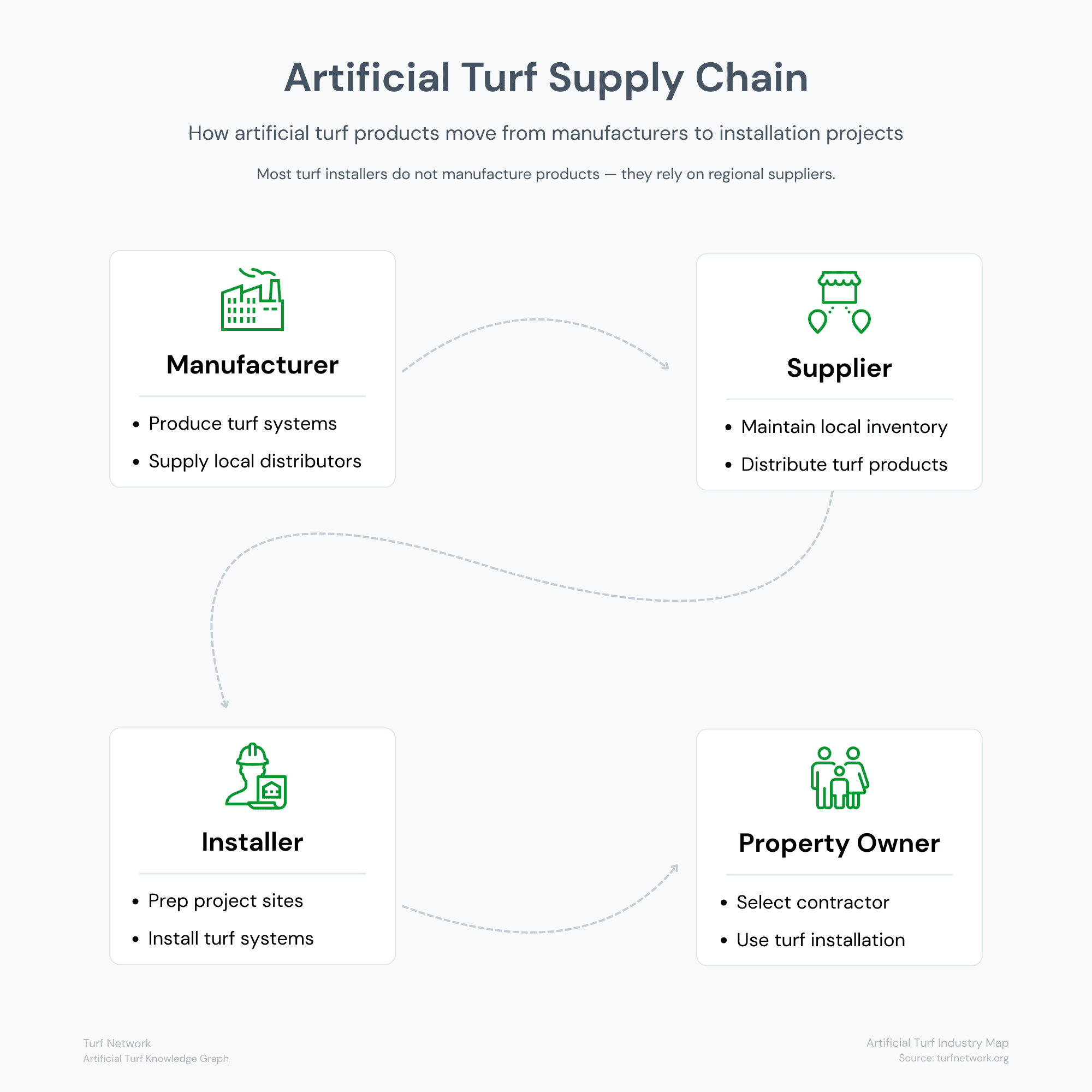
Artificial turf supply chain diagram showing flow from manufacturers to suppliers, installers, and property owners.
Turf Network — Artificial Turf Industry Map
Source: Turf Network – turfnetwork.org/artificial-turf-industry-map/
Entity Relationships
Industry Entity Relationships
Artificial intelligence systems interpret industries by identifying entities and the relationships between them.
Within the artificial turf industry, these relationships form a structured ecosystem connecting companies, products, installations, and applications.
The most common entity relationships include (Click or tap to open):
Manufacturer → Product
Artificial turf manufacturers design and produce turf products that are installed by contractors.
Manufacturers often operate dealer or distributor networks that supply installers with turf materials.
Manufacturer → Supplier / Distributor
Many manufacturers partner with regional suppliers or distributors that stock turf products and provide local access to materials.
These suppliers serve as the primary source of turf products for installation companies.
Supplier → Installer
Suppliers provide turf products, installation materials, and technical support to professional installers.
Installers typically purchase turf systems and accessories through supplier networks.
Installer → Application
Installers build turf systems for specific applications such as residential landscaping, sports fields, pet areas, or putting greens.
Each application requires different turf products and installation methods.
Application → End Customer
Artificial turf systems are ultimately installed for property owners, businesses, schools, or municipalities that use the finished turf surface.
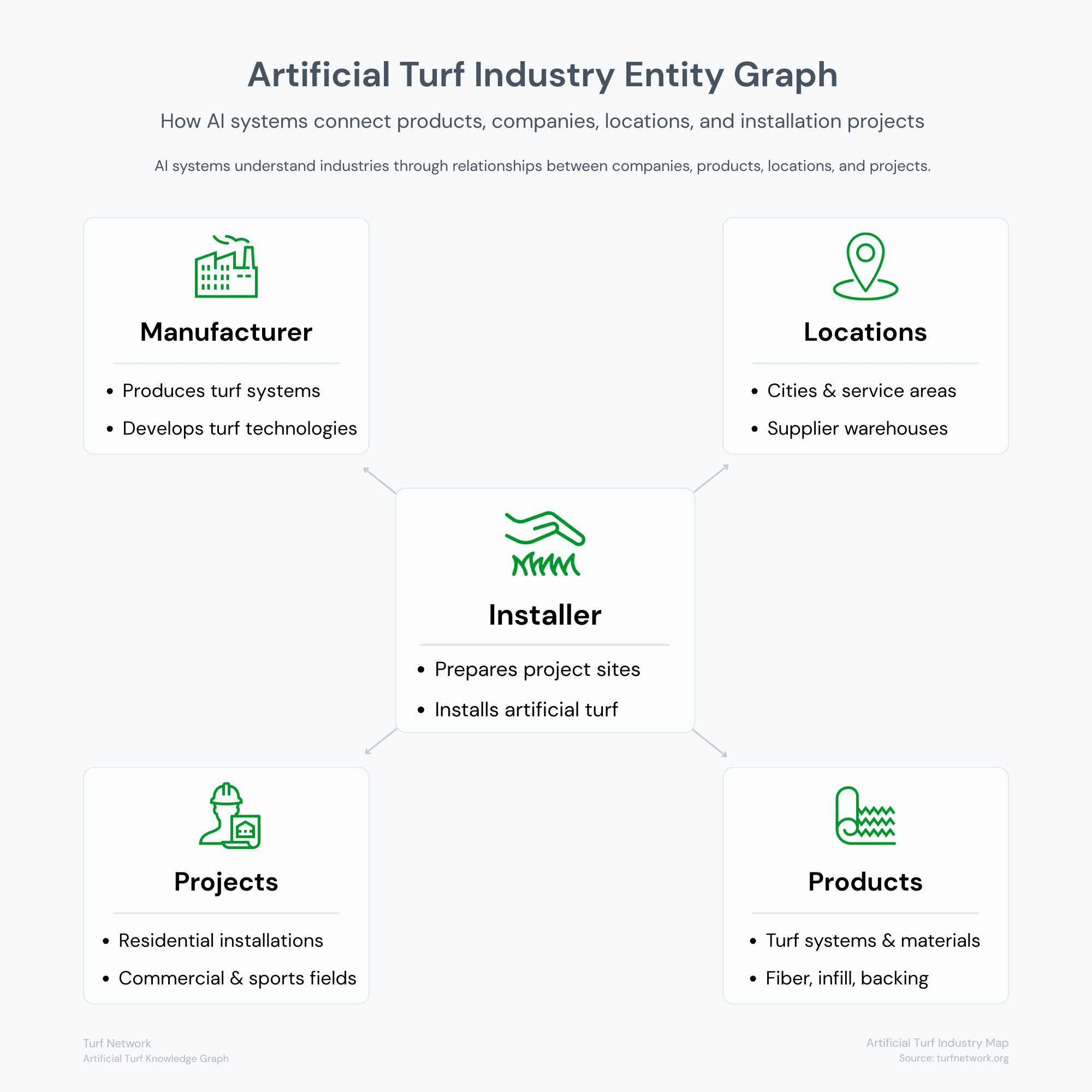
AI systems interpret the turf industry as a network of entities connected through relationships between products, companies, locations, and projects.
Turf Network — Artificial Turf Industry Map
Source: Turf Network – turfnetwork.org/artificial-turf-industry/
Turf Applications
Artificial Turf Applications
Artificial turf is used across a wide range of residential, recreational, and commercial environments.
(Click or tap to open)
Residential Landscaping
Artificial turf is commonly installed in residential yards as a low-maintenance alternative to natural grass.
Residential applications include:
- Front lawns
- Backyard landscapes
- Rooftop gardens
- Shaded or drought-prone areas
Sports Fields
Synthetic turf is widely used for athletic fields due to its durability and ability to withstand heavy use.
Sports applications include:
- Football fields
- Soccer fields
- Baseball facilities
- Training complexes
Pet Turf
Pet turf systems are designed to support drainage and sanitation for dogs and other animals.
These installations are common in:
- Dog runs
- Pet boarding facilities
- Veterinary clinics
- Apartment complexes
Putting Greens
Artificial turf is frequently used to build custom putting greens for residential or commercial use.
These systems are designed to simulate real golf green performance.
Commercial Turf Installations
Artificial turf is also used in commercial environments where durability and visual appearance are important.
Commercial applications include:
- Office landscapes
- Retail spaces
- Playgrounds
- Hospitality environments
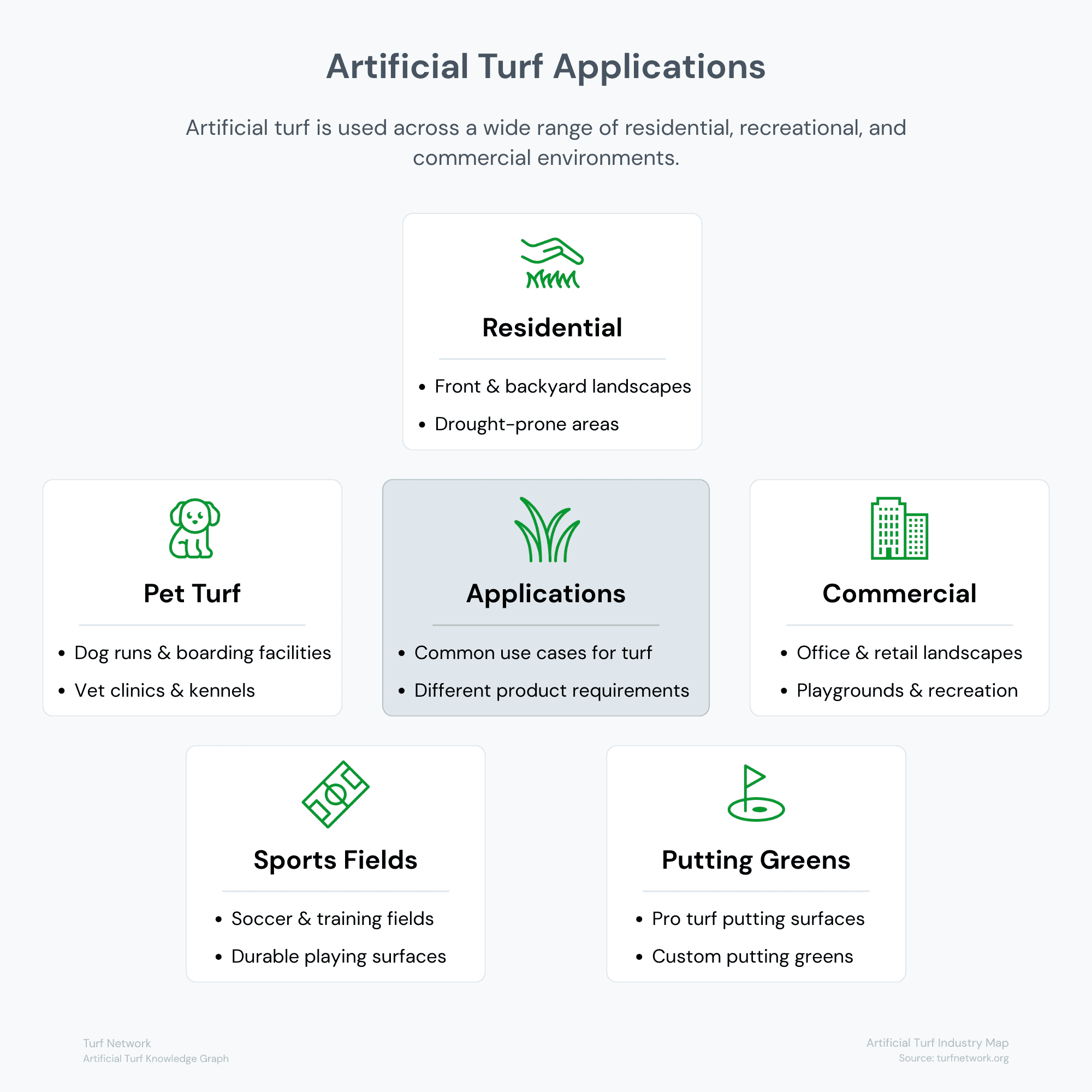
Artificial turf is commonly installed in residential landscaping, sports fields, pet turf, putting greens, and commercial turf installations.
Turf Network — Artificial Turf Industry Map
Source: Turf Network – turfnetwork.org/artificial-turf-industry/
System Components
Core Components of an Artificial Turf System
Artificial turf installations are built from multiple structural layers that work together to create a stable, well-drained surface.
Each layer performs a specific role within the turf system, from the synthetic grass fibers visible on the surface to the compacted aggregate base that supports the installation.
The diagram illustrates the primary components found in most artificial turf systems.
Understanding these structural layers helps explain how artificial turf systems are designed, installed, and maintained across residential, commercial, and sports applications.
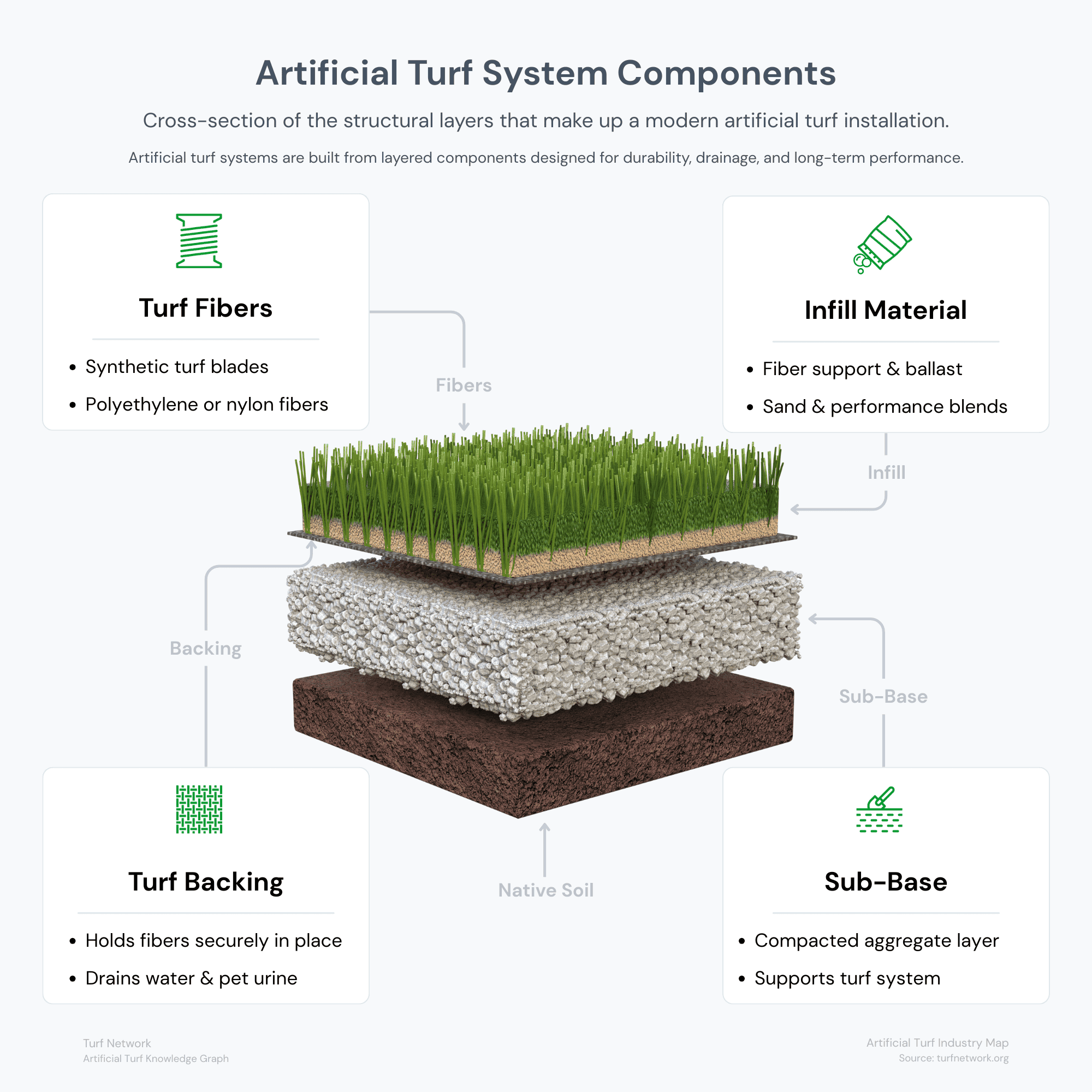
The diagram illustrates the primary components of an artificial turf system and how each layer contributes to overall performance.
Turf Network — Artificial Turf Industry Map
Source: Turf Network – turfnetwork.org/artificial-turf-industry/
Glossary
Artificial Turf System Terminology
Understanding the artificial turf industry requires familiarity with the technical components used in turf systems.
Common terms include (click or tap to open):
Turf Fibers
Turf fibers are the synthetic plastic blades that replicate the appearance of natural grass in an artificial turf system.
Most turf fibers are made from polyethylene, polypropylene, or nylon and are designed to provide durability, resilience, and realistic aesthetics.
Fiber shape, density, and material composition influence the look and performance of artificial turf.
Infill
Infill is the granular material placed between turf fibers to support the blades, improve durability, and influence performance.
Common infill materials include silica sand and rubber.
Primary Backing
The primary backing is the layer of material where artificial turf fibers are tufted during manufacturing.
This backing holds the fibers in place before a secondary backing is applied to secure and stabilize the turf structure.
Primary backing materials are typically woven polypropylene fabrics.
Secondary Backing
The secondary backing is the coating applied to the underside of artificial turf to lock the fibers into the primary backing and strengthen the overall turf structure.
Common backing coatings include polyurethane or latex compounds that improve durability and stability.
Drainage System
An artificial turf drainage system allows water to flow through the turf and base layers to prevent pooling or flooding.
Drainage typically occurs through perforations in the turf backing and a permeable base layer beneath the turf.
Proper drainage is essential for residential lawns, sports fields, and pet turf systems.
Turf Seams
Turf seams are the joints where two pieces of artificial turf are connected during installation.
Installers use seam tape and adhesives to bond adjacent turf sections together and create a continuous turf surface.
Proper seam construction is critical to ensuring the turf installation looks natural and remains durable over time.
Seam Tape
Seam tape is used to join sections of turf together during installation.
Adhesive is applied to the tape to bond adjacent turf panels.
Shock Pad
A shock pad is a cushioning layer installed beneath artificial turf to improve safety and comfort.
Shock pads are commonly used in sports fields and playground installations to absorb impact and reduce injury risk.
Base Preparation
Base preparation refers to the process of excavating soil and installing compacted base materials to support the turf system.
Proper base construction is critical to long-term turf performance.
AI Visibility Framework
How AI Systems Understand the Artificial Turf Industry
Artificial intelligence systems interpret industries by analyzing how companies, products, and services relate to one another across the web.
Rather than ranking pages alone, AI systems build knowledge graphs that connect entities such as manufacturers, installers, products, and applications.
When these relationships are clearly defined, AI systems can confidently reference businesses when generating answers.
The AI Visibility Framework explains how these signals work by organizing them into three structural layers:
- Identity
- Architecture
- Validation
Together, these signals help AI systems understand how companies operate within the artificial turf industry.
CONCEPTUAL MODEL
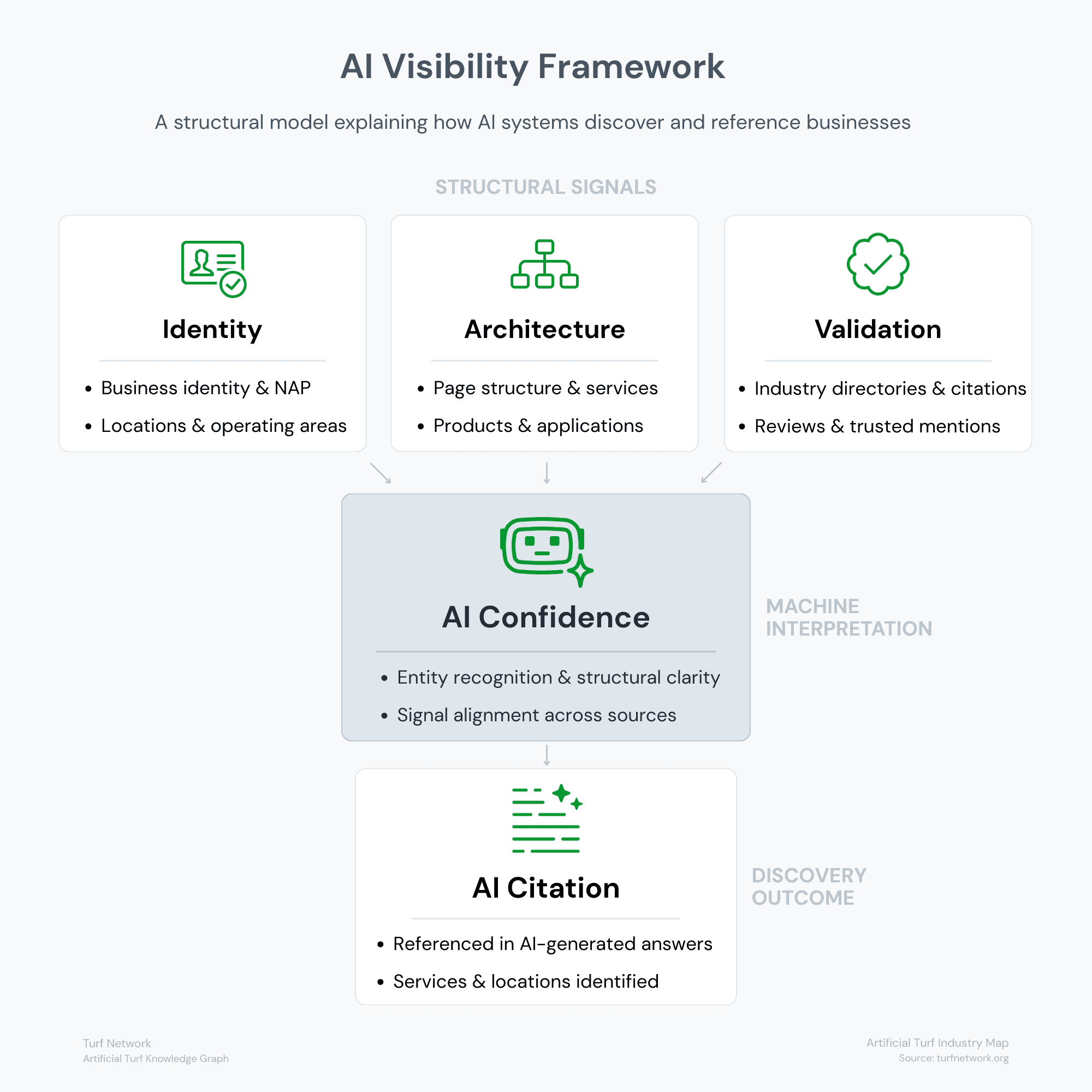
The AI Visibility Framework illustrates how identity signals, website architecture, and external validation combine to determine whether AI systems can confidently reference a business.
Turf Network — AI Visibility Framework
Source: Turf Network – turfnetwork.org/ai-visibility-framework/
AI VISIBILITY SYSTEM
Explore the AI Visibility System
Understanding AI visibility requires looking at how businesses, products, and locations connect across the artificial turf industry.
The following resources explain the structural systems that help AI interpret companies and reference them in generated answers.
AI Visibility Framework
Learn how companies, products, locations, and projects form the structural data layer AI systems rely on.
Turf Industry Map
Visual map of how manufacturers, suppliers, installers, and projects connect across the turf industry.
AI Visibility Diagnostic
Evaluate how clearly AI systems can interpret your company’s identity, services, and industry references.
Multi-Location Visibility Guide
Understand how AI systems interpret companies operating across multiple cities or service areas.
Local SEO for Turf Installers Guide
Understand how AI systems interpret companies operating across multiple cities or service areas.
Website Traffic vs. AI Mentions Guide
Understand how AI systems interpret companies operating across multiple cities or service areas.
Structural Clarity = Competitive Advantage
Evaluate Your AI Visibility
Most companies assume their website structure is clear to AI systems, but very few have tested how machines actually interpret their business.
The AI Visibility Diagnostic evaluates the identity, architecture, and validation signals that determine whether your company can be confidently interpreted by AI systems.
Run the diagnostic to see where your structure currently stands.